
Teacher Support Materials
Insect Apocalypse! Instructional Guide
CENTRAL QUESTION: What happens to bat populations as the insect resources they eat disappear?
TIME: 85-120 MINUTES
Overview:
- INTRODUCTION: Setting the scene (~12 minutes)
Who is Dr. Susy? Why do we care about bats? What is the insect apocalypse? What will I be doing in this investigation? - PART 1: Are you going to eat that? (20-30 minutes)
Do all bats compete for the same food resources? - PART 2: What else can you eat? (45 -60 minutes)
How do bats’ physical features influence what they can eat? - PART 3: Super flexible or super-at-risk? (20-30 minutes)
Will bat species thrive or decline as resources change?
MATERIALS:
- One device (laptop or Chromebook) per student or pair of students
- Printed or Google Doc Research Assistant Notebooks for students to record notes
- White board or other surface for teacher to use while facilitating class discussions
- Additional resources:.
- Bat Measurement Tips (Provide to students for Activity 2)
- Student Learning Assessment Tool
- Student Rubric for Presenting Arguments
- Student Rubric for Assessing Learning Outcomes
STANDARDS ALIGNMENT:
NGSS- MS-LS2-1 Ecosystems: Interactions, Energy, and Dynamics. Analyze and interpret data to provide evidence for the effects of resource availability on organisms and populations of organisms in an ecosystem. [Clarification Statement: Emphasis is on cause and effect relationships between resources and growth of individual organisms and the numbers of organisms in ecosystems during periods of abundant and scarce resources.]
- Standard 6.4.1: Analyze data to provide evidence for the effects of resource availability on organisms and populations in an ecosystem. Ask questions to predict how changes in resource availability affect organisms in those ecosystems. Examples could include water, food, or living space in Utah environments. (LS2.A)
- Speaking & Listening Standard 1: Engage effectively in a range of collaborative discussions (one-on-one, in groups, and teacher-led) with diverse partners on grade 6 topics, texts, and issues, building on others’ ideas and expressing their own clearly.
- Language Standard 6: Acquire and use accurately grade-appropriate general academic and domain-specific words and phrases; gather vocabulary knowledge when considering a word or phrase important to comprehension or expression.
Common Core State Standards (CCSS): Mathematics
- Standards in Mathematical Practice 2: Reason abstractly and quantitatively.
- Standards in Mathematical Practice 3: Construct viable arguments and critique the reasoning of others.
- 6.5P: Develop understanding of statistical variability.
GETTING STARTED
Before class...
- Check permissions on students’ devices to ensure they can visit researchquest.org and that they are able to download pdfs from that website.
- Login at www.researchquest.org using the email address and password you used to create your Research Quest account.
- Click “My Account” to access your unique student access code to share with your class.
- Note: Be sure to use the student URL <www.researchquest.org/student> and access code for classes. This allows you to keep your administrative account free of student activity. Students should not create their own Research Quest account.
- Click “My Account” to access your unique student access code to share with your class.
- Review this lesson plan, making notes on standards and/or skills you would like to focus on with your students.
- Review the following recommended strategies for optimizing student learning outcomes.
- During or after the investigation, you likely will want to pause for whole-class discussion to provide practice sharing and responding to peer ideas.
- Build a shared vocabulary for the learning tasks. Identify target vocabulary words from the vocabulary included in this guide and descriptions of student activities. Encourage students to use these words often. Model correct usage if needed.
- Think about places where you can activate prior knowledge by prompting students to relate new concepts to a familiar context.
- Think about how to integrate this EPIC investigation with other curriculum-aligned activities.
- Create and engage student interest in the program by expressing your enthusiasm and/or describing your personal interest in studying museum specimens and learning more about mammalogy, entomology and ecology. You may also want to emphasize that students will be working with authentic materials on research questions that scientists address in their own work. The scientist guide in this investigation is a real scientist studying museum specimens – not an actor!
- Introduce students to sentence stems that reinforce flexible thinking and help students verbalize their thought processes:
- “I see...”
- “I think...”
- “I wonder...”
- Provide a brief overview of the lesson to the class.
- Introduce the objectives the class will be focusing on today.
- Teacher Login at: www.researchquest.org using the email address and password you used to create your Research Quest account. Then, navigate to the Investigations tab.
- Students Login at: www.researchquest.org/student using the Student Access Code unique to your account.
- Locate and launch this investigation (“Insect Apocalypse”)
- Once logged in, students will be on the landing page for this investigation.
INTRODUCTION: Setting the scene
OVERVIEW
Students will identify and explain the difference between natural materials and synthetic materials.
1. INTRODUCTION
WHAT STUDENTS ARE DOING
Students will watch four short videos that provide context for the investigation. You may find it easiest to watch these videos together as a class or ask students to use headphones if they watch them individually.
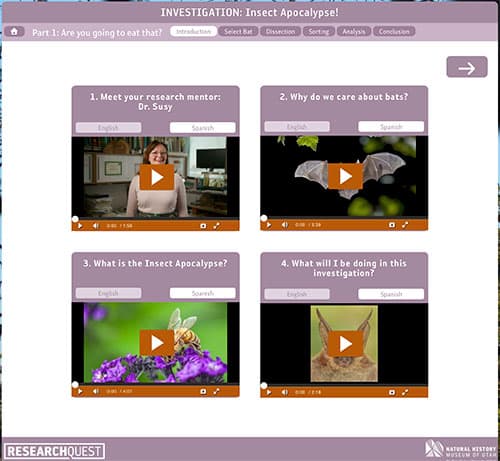
The four videos include:
- Meet your research mentor: Dr. Susy (time = 1:59)
- Why do we care about bats? (time = 3:39)
- What is the Insect Apocalypse? (time = 4:07)
- What will I be doing in this investigation? (time = 2:18)
TIPS FOR TEACHERS
Before each video, direct students' attention by asking them to listen for something specific. For instance, you might ask them to listen for something interesting they learned about Dr. Susy, or to listen for reasons bats are important.
PART 1: Are you going to eat that?
Do all bats compete for the same food resources?
(20-30 minutes)
OVERVIEW
Students work with Dr. Susy to examine existing bat diets to determine whether bats are competing for their food resources and whether this will make it difficult for a bat to survive.VOCABULARY TO SUPPORT:
Species, compare, compete/competition, resources, stomach contents, dissect/dissections, lab.BIG IDEAS TO SUPPORT:
Bats with overlapping habitats (i.e., bats that live in the same geographic range) may compete for food. Different types of bats eat different types of insects.ASSESSMENT
In this section, the instructor may find it useful to focus on the following critical thinking skills, defined in more detail in the Student Learning Assessment Tool located under the “Teacher Support” tab of the website:- Comparison: Students will compare data from the stomach contents of two species of bats to identify whether these bat’s diets overlap.
- Flexible thinking: Students may form ideas about which bat would out-compete the other bat but should remain open to changing or adjusting their ideas if they are presented with new evidence.
Introduction
1. OVERVIEW
WHAT STUDENTS ARE DOING
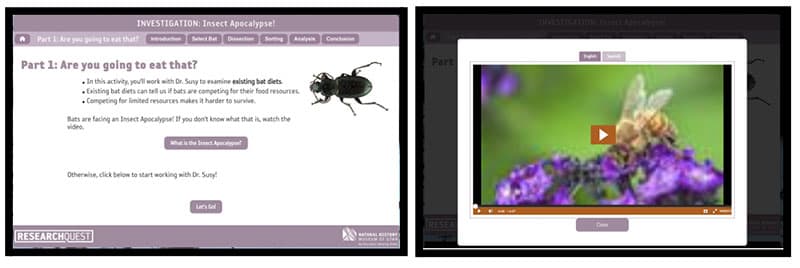
Students watch the video: What is the Insect Apocalypse? And learn they are going to work with Dr. Susy to examine bat diets. (Note: The video can be skipped if students already watched it in the introduction section.)
TIPS FOR TEACHERS
Check for understanding of big ideas:
- Existing bat diets can tell us if bats are competing for resources.
- Competing for limited resources makes it harder to survive.
Strategies for support:
- Before the video: Ask students what they think an Insect Apocalypse is and why it might be a problem.
- After the video: Ask students how they would describe the problem Dr. Susy shared.
2. BACKGROUND INFORMATION
WHAT STUDENTS ARE DOING
Students text back and forth with Dr. Susy by choosing emoji responses and clicking enter to submit. Through this communication method, they glean background information and are set up for the next activity.
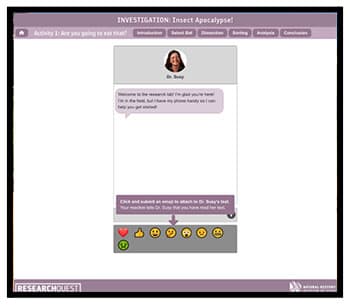
As reference, these are the text messages:
- Welcome to the research lab! I’m glad you’re here! I’m in the field, but I have my phone handy so I can help you get started!
- To figure out how the Insect Apocalypse will affect different bat species, we need to know which insects they eat now.
- Bats in North America eat insects, but different bat species eat different kinds of insects.
- We can compare what different bats eat to figure out if they compete. Competition makes it harder to survive when resources are limited.
- To figure out what a bat eats, we analyze its stomach contents. You might be wondering how we do that…
- We dissect specimens. The bat’s stomach contents tell us what the bat was eating just before it died. It’s like CSI: Museum.
- I have selected bat specimens for you to dissect in our virtual lab. Pick a pair of bats you want to explore.
- You’ll look at what the bats ate and determine if they compete for resources. You'll do great! I’ve left you instructions from my notebook for guidance! TTYL!
3. SELECT
WHAT STUDENTS ARE DOING
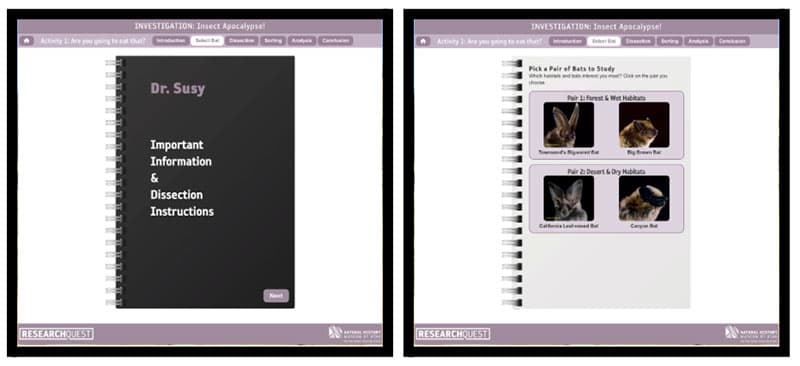
Students chose a pair of bats to study. They can either choose pair 1, which lives in forest and wet habitats, or pair 2, which lives in desert and dry habitats.
TIPS FOR TEACHERS
Strategies for support:
Students can elect to study just one pair or can go back and study the other pair after they have collected data for the first pair. Depending on what strategy you used, you could:
- Ask individual students to share out what they learned about each pair, or,
- Ask students to reflect on their own efforts with each pair in order to determine what was the same and what was different about the bats that inhabit each type of habitat.
Support collaboration: Collaboration works when everyone has a clearly defined role but can combine their efforts to accomplish a larger goal. If you want your class to work on their collaboration skills, have students work in pairs or small groups with half the group working with one pair of bats and the other half researching the other pair of bats.
DISSECTION
1. BACKGROUND INFORMATION
WHAT STUDENTS ARE DOING
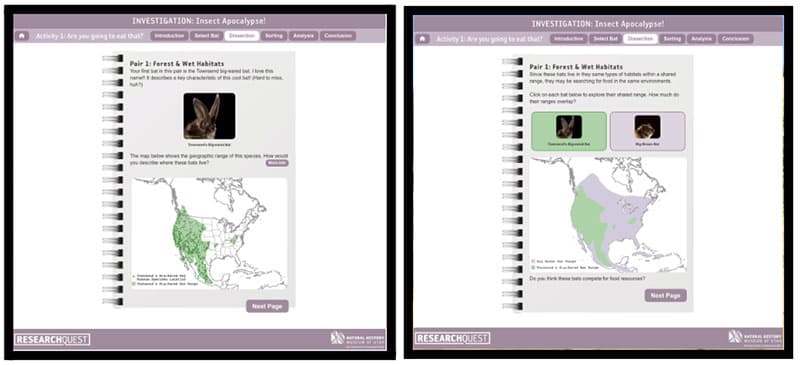
Students are presented with background information and a map of where each bat lives. They will be using information about how bat populations overlap to make predictions about whether these bats will compete for resources.
Students are asked to reflect on the following questions:
- How would you describe where these bats live?
- How much do the bats’ ranges overlap?
- Do you think these bats compete for resources?
TIPS FOR TEACHERS
Strategies for support:
Activate prior knowledge by helping students make connections between this activity and previous knowledge they have about organisms’ reliance on resources and competition between species.
Do your students need extra guidance?
You may need to model how to answer these questions using the maps provided.
Here is an outline you may use with your class:
- Model how you would answer the first question for one of the bats by looking for clues in the text and on the map. Talk aloud and project your screen so that students can follow along.
- Ask the class to answer the first question for the second bat and to share that answer with a partner. Ask for volunteers to share out with the whole class.
- Ask students to complete the second and third questions working with their partner or small group. Monitor class discussions and provide support as needed.
- If your students need more guidance, consider walking through the entire activity 2 as a class with one pair of bats and then allowing students to work more independently as they complete the activity for the second pair of bats.
Modify this outline as needed based on your students’ abilities and your instructional goals for the lesson. You may find that students need more or less guidance from you in order to reason about how bat’s geographic ranges (i.e., where they live) may impact their competition for resources.
2. DISSECTION
WHAT STUDENTS ARE DOING
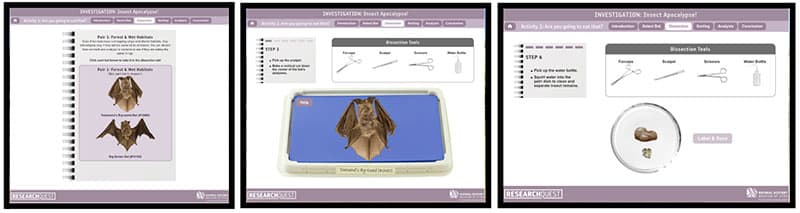
Students complete a simulated dissection of the stomach of two types of bats associated with the category of habitat they chose to study. This will show them what types of insects each bat eats.
TIPS FOR TEACHERS
Is someone stuck?
Step-by-step instructions are in the notebook on the top left side of the screen.
Each step of the dissection must be completed in the order and with the tool detailed in the notebook.
SORTING
1. ANALYZE
WHAT STUDENTS ARE DOING
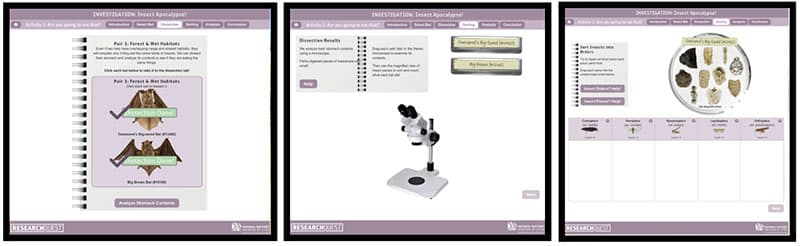
Students will drag a petri dish down to the microscope. After they have dragged the petri dish to the microscope, they will be prompted to analyze stomach contents in the petri dish by sorting insect remains into insect orders (i.e., types of insects).
TIPS FOR TEACHERS
Is someone stuck?
Students can find instructions in the notebook on the top left of the page. There are also tips that explain what an insect order is and why they are looking at pieces of insects.
- For help identifying insect remains, students can view examples of each category by clicking the “?” icon next to the name of each category.
- Insect pieces will only “stick” if placed in the correct order. Students should be able to complete this activity relatively quickly by trial and error if they have trouble getting a sense of which insect pieces they are seeing.
It is less important that they begin to recognize insect pieces and more important that they start to reflect on the distribution of insects eaten by each bat.
ANALYSIS & CONCLUSION
1. ANALYZE
WHAT STUDENTS ARE DOING
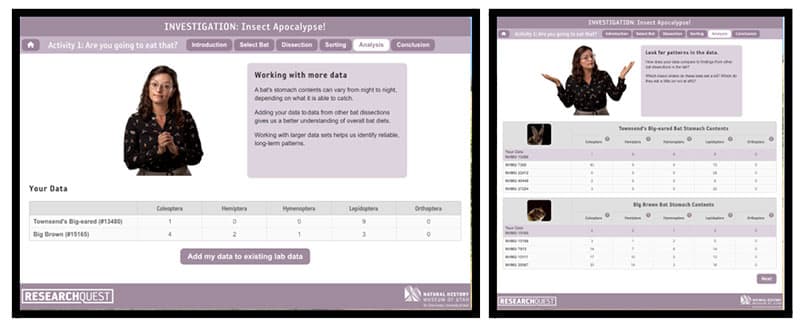
Students see their data and add it to a larger data set, which is important to model that decisions are not based on small sample sizes. Students are prompted to think about and discuss the following questions:
- How does your data compare to data from other bat dissections in the lab?
- Which insect orders do these bats eat a lot? Which do they eat a little (or not at all)?
TIPS FOR TEACHERS
Check for understanding: Emphasize that one data point (i.e., the contents of one bat stomach from one night) is not enough to make generalizations about what these types of bats eat. However, if we look at a larger data set, we can start to identify patterns in what bats that live in these categories of habitats eat or don’t eat. Potential questions to ask your students to guide them towards this understanding:
- How might a bat’s diet change from day-to-day?
- This bat’s geographic range covers a lot of space. Do you think all bats in this area eat the same exact things?
- Why should we look at data from multiple bats and multiple nights? (Possible answer: This helps us see patterns over time and geographic space. Data from one bat may or may not be similar to other bats. Our research question is asking what would happen to bats if there was an insect apocalypse so we want to understand patterns over time and space.)
Take it further: You might engage students in a discussion about outliers in data and matching research questions to data collection techniques.
For example, if your research question was “what did this Big Brown Bat eat for its last meal?” you could answer that by looking at just the stomach contents of that one bat. In this case, you would have exactly the evidence you need to answer your question.
- If your question was “What do Big Brown Bats in my neighborhood eat?” you would not want to catch all the bats in your neighborhood and analyze all of their stomach contents every night. This would not be practical. But, if you could analyze the stomach contents from a few bats over time, you could develop an evidence-based hypothesis about what the Big Brown Bats in your neighborhood eat.
- If your question is “What do Big Brown Bats eat?” you would need to gather data from multiple Big Brown Bats in multiple places across the geographic range of these bats.
2. INTERPRET
WHAT STUDENTS ARE DOING
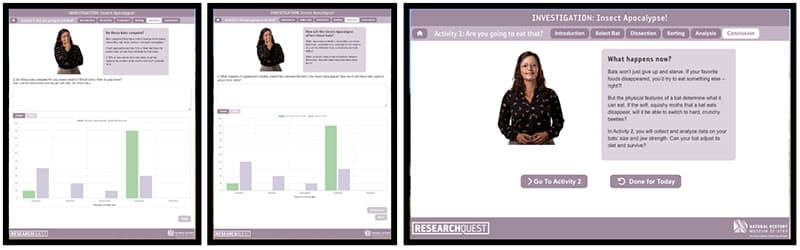
Students are using data about what types of insects were found in bat stomachs to answer two reflection questions:
- Do these bats compete for any insect orders? Which ones? How do you know? (Hint: look for orders where both bats get more than 10% of their diet.)
- What happens if lepidoptera (moths, butterflies) become limited in the Insect Apocalypse? How much will these bats need to adjust their diets?
When they have finished answering the questions, they are given the opportunity to download their data and responses to a PDF. You can collect the PDF to review their responses and identify what support your students need to make sense of their data.
TIPS FOR TEACHERS
Note: Because we don’t require student logins, they have to download the PDF to save their data as they won’t be able to retrieve it later.
This is the end of Part 1 of the investigation. Students can continue on to Part 2 or finish the investigation another day.
PART 2: What else can you eat?
How do bats’ physical features influence what they can eat?
(45 -60 minutes)
OVERVIEW
In this section, students will gather data from museum specimens using a measurement tool. They will analyze the data they collect and use that data to make inferences about how the size and bite force of their bats will affect what the bat is able to eat.
VOCABULARY TO SUPPORT:
Physical features, specimens, museum collections, habitat, geographic range, bite, bite force BIG
IDEAS TO SUPPORT:
- An insect apocalypse means bats may face increased competition for the food they eat.
- Bats’ size and bite force determine what it can eat, which may be different from what it regularly eats.
- Some bats may be able to adjust their diet if something they eat becomes scarcer or disappears.
- Some bats will not be able to adjust their diet.
ASSESSMENT
In this section, the instructor may find it useful to focus on the following critical thinking skills, defined in more detail in the Student Learning Assessment Tool located under the “Teacher Support” tab of the website:
- Connections: Students make connections between multiple pieces of evidence. In this section students should be making connections between evidence they have about what bats eat and evidence they have about the size and bite force of the bat as they construct a claim about which bat would most easily adjust its diet if it lost a food source.
- Comparison: Students make clear comparisons between observations drawn from multiple data sources. In this section, students will make comparisons between the diet, overall size, and bite force of two different bat species.
INTRODUCTION
1. PREDICT
WHAT STUDENTS ARE DOING
Students begin their engagement with this problem space by making predictions about what physical features they think will influence what a bat is able to eat.
When they compare their answers to Dr. Susy’s answers, they will find that all the listed physical features are important and can read Dr. Susy’s explanations about how each physical feature impacts what bats are able to eat. Dr. Susy will then note that while all these physical features are important, we can learn a lot from examining bat’s size, and bite strength.

TIPS FOR TEACHERS
Check for understanding:
- Which physical features affect bat’s diets?
- How do these physical features impact bat’s diets?
- Which physical features are students going to investigate, and why?
2. EXPLORE
WHAT STUDENTS ARE DOING
Students explore the image to learn more about how bats are stored in museum collections. This step is optional; the information included here is not necessary background information for the rest of the activity, but it provides context about where the to-be-measured specimens come from (i.e., preserved bat specimens).
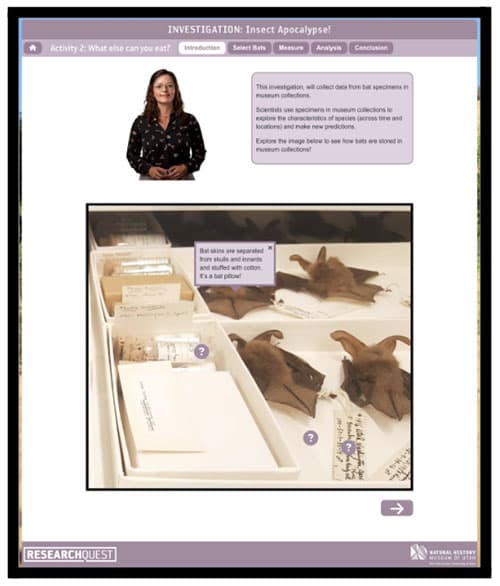
Is someone stuck? Students can click on “?” icons to learn more about how bats are stored in museum collections.
TIPS FOR TEACHERS
You may find it helpful to review this step all together as a class as a way to foster engagement and excitement about the upcoming steps.
SELECT BATS
1. CHOOSE
WHAT STUDENTS ARE DOING
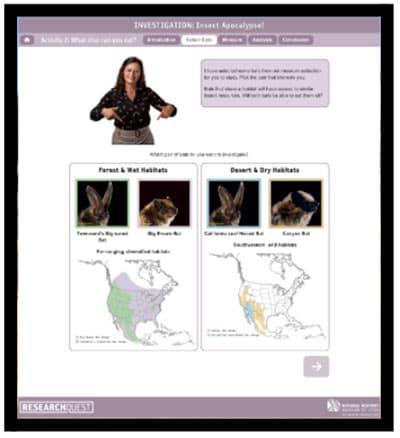
Students choose a pair of bats to investigate:
- Townsend’s Big-eared Bat & Big Brown Bat, represent forest and wet habitats.
- California Leaf-nosed Bat and the Canyon Bat represent desert and dry habitats.
TIPS FOR TEACHERS
It does not matter what pair of bats students choose, although if you want to foster collaboration skills you might consider assigning some students to one type of habitat and others to the other type so that you can have them pair up in small groups later to share their findings.
NOTE: If you completed Activity 1, students might prefer to pick the same bats as the ones they dissected. However, this is not necessary. Students can study new bats in Activity 2 if they wish.
MEASURE
1. GATHER
WHAT STUDENTS ARE DOING
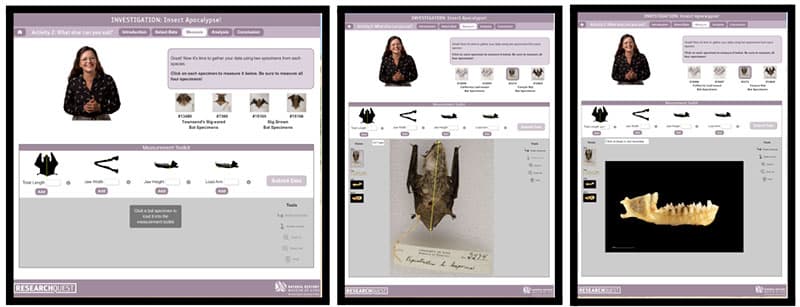
Students select a bat (using the images under Dr. Susy’s instruction) to load into the measurement tool.
After the bat specimen appears in the viewer, students will do the following:
- Use the measurement tool to measure the total length, jaw width, jaw height, and load arm of the bat.
- Switch between views of the specimen, specimen tag, jaw, and skull.
- Use the measurement tools to rotate images and zoom in and out.
- Click “add” to record their measurements.
- Click “submit data.”
- Select a new bat specimen to collect data and repeat until all bat specimens have been measured.
Is someone stuck? Take a look at our measurement guide that includes our top 4 measurement tips.
TIPS FOR TEACHERS
Functionality hints:
When measuring, click to place a marker (i.e., a yellow dot). Students can place multiple markers for a single measurement. Clicking a marker that has already been placed will remove it. This is a good way to undo an inaccurate marker.
2. ANALYZE
WHAT STUDENTS ARE DOING
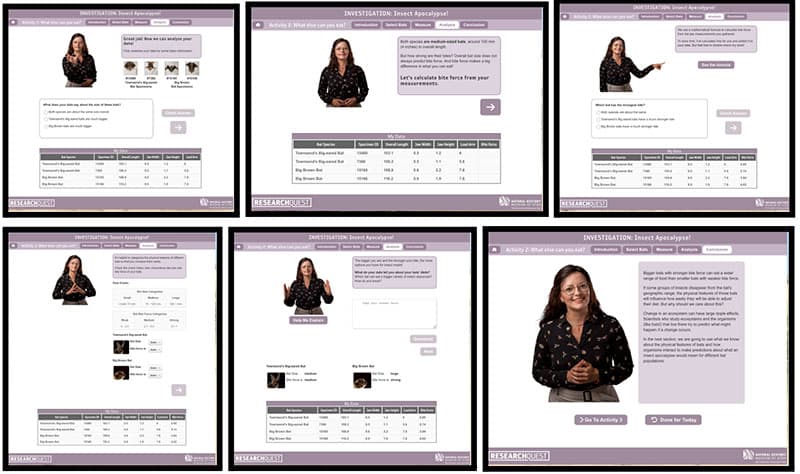
Students will look at their data and answer reflection questions. They click “check answer” to check their answer and the arrow to move on to the next question. Dr. Susy’s feedback explains whether she agrees or disagrees with students’ responses and explains why.
As students complete this section, they will use dropdown menus to classify their two species’ size (small, medium, or large) and bite force (weak, medium, or strong). Students should categorize their measurement data using the on-screen category guidance (i.e., measurement ranges for each category).
Students then answer the following questions:
- What does your data say about the size of these bats?
- Which bat has the strongest bite?
- What does your data tell you about your bats’ diet?
- Which bat can eat a bigger variety of resources? How do you know?
TIPS FOR TEACHERS
Hint: If individual bat measurements align to different categories, students should use the average for each species to assign categories.
Opportunity for assessment:
Students will be given the option to download their responses as a PDF. Collect students PDFs to get a better idea of how well they are connecting their evidence to their reasoning in their responses of what bats can eat. Use this to identify gaps in students’ understanding.
Supporting collaboration:
Correct categorization depends on measurement accuracy. Comparing students’ answers can support whole class discussion about variability in science and data accuracy. You could use the information gained from students’ PDFs to construct mixed ability groups where students can share and receive feedback and advice from their peers about their reasoning and discuss potential differences in their data.
This is the end of Part 2. Students can continue to Part 3 or stop here for the day.
CONCLUSION: Super flexible or super-at-risk?
Will bat species thrive or decline as resources change?
(20-30 minutes)
OVERVIEW
In this section, students reason about the implications of a bat species’ diet, size, and bite force in order to construct an argument about the role of resource availability on future populations for each bat species.
VOCABULARY TO SUPPORT
Decline, rapid, populations, insect orders, competition, specialized, diet, dissection, typical, high risk, low risk, moderate risk.
BIG IDEAS TO SUPPORT
- Bats are limited in what they can eat by the size and strength of their jaws.
- Some insects are hard for bats to eat.
- Bats compete for resources (i.e., food).
- If food resources become scarce, competition becomes more intense.
- Some bats might be able to adapt their diet if their normal food sources become more scarce.
ASSESSMENT
In this section, the instructor may find it useful to focus on the following critical thinking skills, defined in more detail in the Student Learning Assessment Tool located under the “Teacher Support” tab of the website:
- Comparisons: Students will make direct comparisons about the dietary coverage of two bat species, articulating similarities and differences.
- Connections: Students make connections between multiple pieces of evidence. In this section students should be making connections between evidence they have about what bats eat and evidence they have about the size and bite force of the bat.
CONCLUSIONS
1. REVIEW THE PROBLEM SPACE
 WHAT STUDENTS ARE DOING
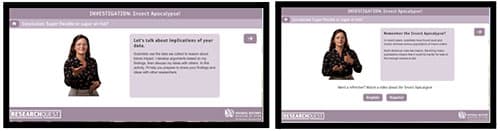
Students review the problem space and watch an optional video about the Insect Apocalypse, if needed.
TIPS FOR TEACHERS
Check for understanding.
Check your students' understanding of the Insect Apocalypse phenomenon. Highlight the following points:
- Scientists have found rapid declines across populations of insect orders.
- Since North American bats eat insects, this could mean a decline in resources (i.e., food) for bats.
Need a review?
You may choose to have students watch the Insect Apocalypse video to remind them of the premise of this phenomenon.
These discussions are optional, but they may help students make connections between what they know about resource availability and interactions between organisms.
2. SELECT THE BAT PAIR
WHAT STUDENTS ARE DOING
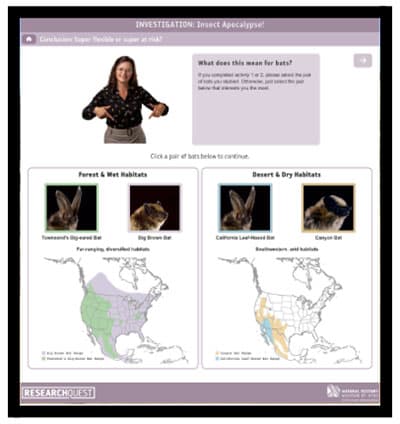
Students select a pair of bats, ideally the bats that they selected in Activity 2. If they did not complete that activity, they can select any pair they want and still be able to complete the activity.
3. REFLECTION 1
WHAT STUDENTS ARE DOING
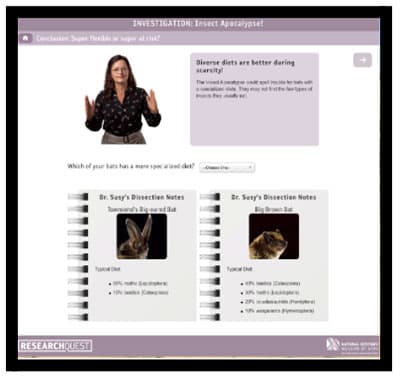
Students identify which bat has a more specialized diet, drawing on their previous research and Dr. Susy’s notes.
Students will select an answer from a drop-down menu and receive feedback that either prompts them to try again with additional information or notes Dr. Susy’s agreement with their answer.
TIPS FOR TEACHERS
Check for understanding: Students should be able to reason about the implications of specialized diets. Questions you can ask:
- What does it mean for a bat to have a specialized diet?
- For bats with specialized diets, what would happen if the special foods they eat disappeared?
Take it further! To explore the concept of specialized and generalized diets even more, talk with students about what the benefits might be of specialized diets–particularly in ecosystems where there are many organisms and a large variety of resources.
- How can eating within a specialized niche (occupied only by you!) be a helpful adaptation?
- What are the benefits of a generalized diet? When would that be a helpful adaptation?
- When might that be a challenge? (You may find it helpful to refer back to findings about competition in Activity 1.)
These discussions are optional, but they may help students make connections between what they know about resource availability and interactions between organisms.
4. REFLECTION 2
WHAT STUDENTS ARE DOING
Students analyze interactive graphs that show the relative hardness and size of five insect orders. Students can turn insect layers on and off by clicking an insect order in the graph legend. This will help them compare and contrast different insect orders.
On this page, students are guided in their exploration by two reflection questions:
- What types of insects are the softest, smallest meals?
- What types of insects are the hardest, largest meals?
After answering these questions using a drop-down menu, they will be given the chance to compare their responses with Dr. Susy’s response.
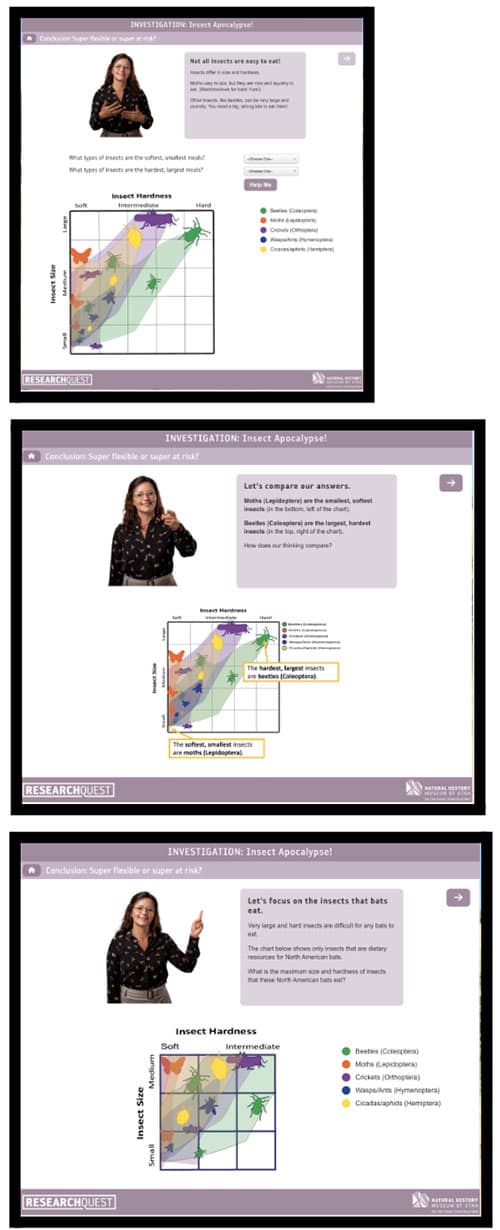
Is someone stuck? Prompt students to click the “Help me” button if they need guidance interpreting the graph.
TIPS FOR TEACHERS
Provide additional support by modeling your reasoning for students. You may find it useful to provide additional modeling for students to help them understand how to interpret this graph. You could walk through one example with the class or a small group and then give students the chance to try it out for themselves with the next graph.
Alternatively, you could walk through the entire activity with your class for one pair, modeling and asking for student input as you complete the activity as a class. Then, you could ask students to work individually or in small groups to complete the activity for the second pair of bats. This would allow students the chance to learn first from a more guided approach and then to apply what they have learned to a similar example.
5. REASONING
WHAT STUDENTS ARE DOING
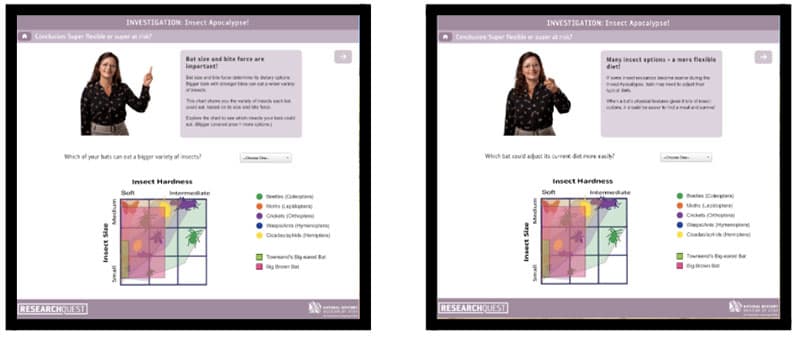
Students analyze a graph that shows insect size and hardness as well as the dietary options for each bat.
Dietary options are based on each bat’s size and bite force. Students can use the graph legend to look at each bat individually (or together).
Students will answer the following question and compare their answer to Dr. Susy’s answer before moving on to the next page:
- Which of your bats can eat a bigger variety of insects?
On the next page, students will see the same graph but with a new reflection question to answer and receive feedback on before moving on:
- Which bat could adjust its current diet more easily?
TIPS FOR TEACHERS
Encourage students to compare the size of each bat’s diet – the area of insects covered helps students visualize the range of insect resources it could eat.
Class discussion: Ask students to share how they answered these questions and explore the reasoning behind their answers. You may encourage student’s science communication skills by having students share in small groups so that they can share and explain their thinking to their peers.
6. PREDICT
WHAT STUDENTS ARE DOING
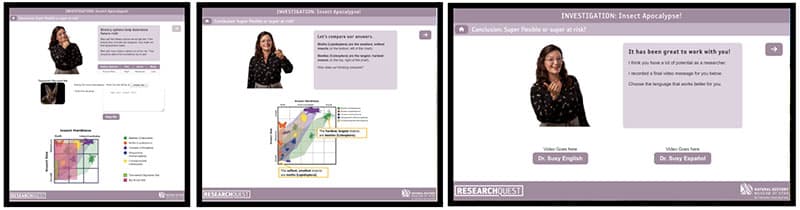
Students analyze whether the bats they are studying are at high, moderate, or low risk if the insects they normally eat disappear. Students use a drop-down to select their predicted risk level and explain their reasoning in a text box. Then, they answer the same questions for the second type of bat and are able to download their responses.
TIPS FOR TEACHERS
Assessment opportunity: Consider gathering student’s downloaded responses so that you look more closely at how students are using evidence to support their reasoning and identify opportunities to build on and expand students’ abilities.
Take it further! If you find that students need additional support in developing their argument, consider completing the Mysteries of Cleveland Lloyd Dinosaur Quarry: What Dinosaur Did these Bones Come From? Research Quest Investigation, which focuses heavily on gathering and evaluating evidence.
This is the end of Part 3 and of the investigation. Check out one of our other Research Quest investigations on our website, https://researchquest.org..