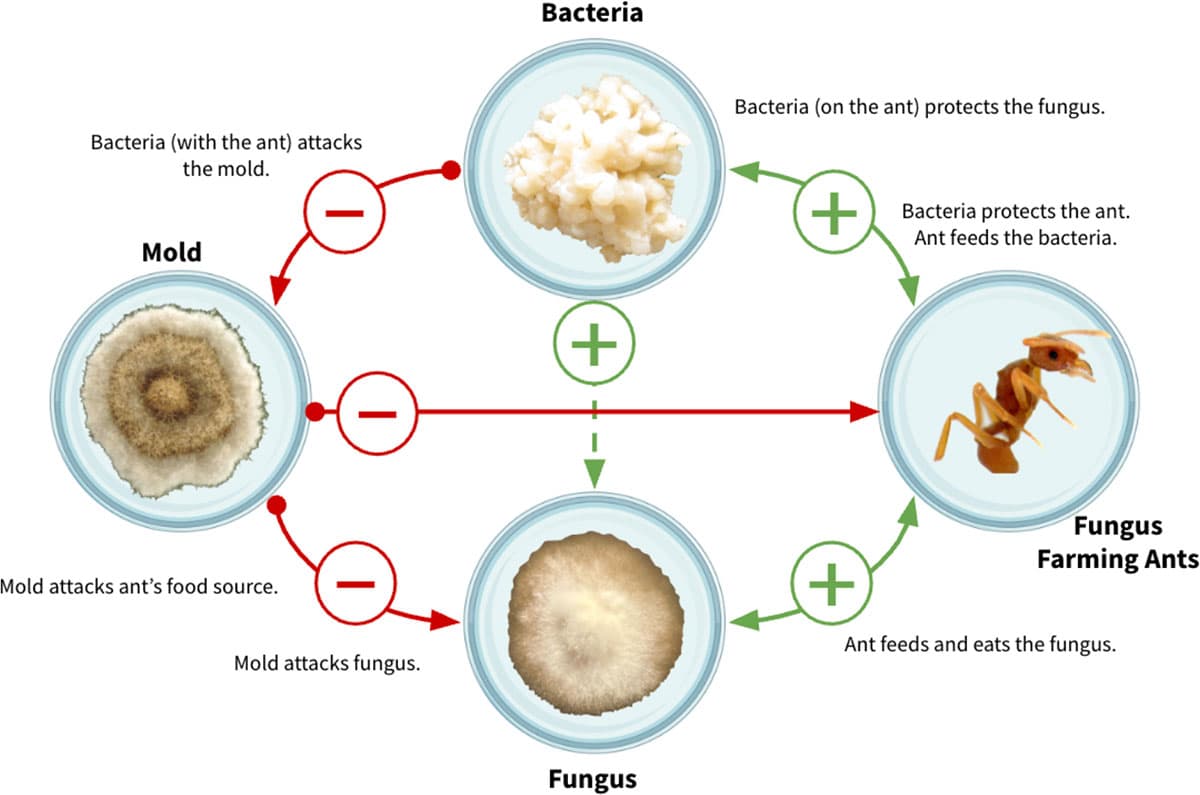
Teacher Support Materials
Fungus Farming Ants Instructional Guide
CENTRAL QUESTION: Why are fungus farming ants so good at surviving?
TIME: 60-90 minutes
Overview:
- Meet the Team (5-10 minutes)
What is a fungus farming ant? - PART1: Warm-up (15-20 minutes)
What is a fungus farming ant? - PART 2: Research (20-30 minutes)
How do organisms in a fungus farming ant community interact?- Be the Ant: How do fungus farming ants grow fungus?
- Be the Scientist: How do scientists study fungus farming ants?
- PART 3: Communicate (20-30 minutes)
Why are fungus farming ants so good at surviving?
MATERIALS:
- One device (lapto or Chromebook) per student or pair of students
- Printed or Google Doc Research Assistant Notebooks for students to record notes
Choose between three different notebooks depending on your class abilities and learning goals. - Whiteboard or other surface for the teacher to use while facilitating class discussions
- Additional resources:.
STANDARDS ALIGNMENT:
NGSS- 3-LS2-1 Ecosystems: Construct an argument that some animals form groups that help members survive.
- Standard 3.2.4: Construct an explanation showing how variations in traits and behaviors can affect the ability of an individual to survive and reproduce. Examples of traits could include large thorns protecting a plant from being eaten or strong smelling flowers to attracting certain pollinators. Examples of behaviors could include animals living in groups for protection or migrating to find more food. (LS2.D, LS4.B)
- Speaking & Listening Standard 3.SL.2: Speak clearly and audibly while asking and answering questions about a topic and key details presented in various media and formats.
- Integration of Knowledge & Ideas 7: Use information gained from illustrations (e.g., maps, photographs) and the words in a text to demonstrate understanding of the text (e.g., where, when, why, and how key events occur).
Utah Social Studies Standards (as an extension activity)
- Standard 3.3.1 Your Community: Analyze how their community has been shaped by the diverse people who have resided within it. Compare primary and secondary sources (when available) from or about these people
- Standard 3.2.3 Your Community: Define their own cultures or the cultures of their communities (for example, art, music, food, dance, system of writing, architecture, government to which they are regularly exposed or of which they are part).
Utah Art Standards (as an extension activity)
- Standard 3.T.CO.1: Identify similarities between story elements and personal experiences in dramatic play or guided drama experiences.
GETTING STARTED
Before class...
- Investigation Link
- Login to your Research Quest account. Click on “My Account” in the top right. Then, click on the orange Student Access Code bar and you will see the code your students need to access the investigation.
- Direct students to the student login page and have them login using your personal STUDENT ACCESS CODE. Note: students DO NOT need to create a Research Quest account.
- On the page that loads, have students scroll to the Fungus Farming Ants investigation launch link.
- Review this lesson plan, making notes on standards and/or skills you would like to focus on with your students.
- Review the following recommended strategies for optimizing student learning outcomes.
- During or after the investigation, you likely will want to pause for whole-class discussion to provide practice sharing and responding to peer ideas.
- Build a shared vocabulary for the learning tasks. Identify target vocabulary words from the vocabulary included in this guide and descriptions of student activities. Encourage students to use these words often. Model correct usage if needed.
- Think about places where you can activate prior knowledge by prompting students to relate new concepts to a familiar context.
- Think about how to integrate this EPIC investigation with other curriculum-aligned activities.
- Create and engage student interest in the program by expressing your enthusiasm and/or describing your personal interest in studying museum specimens and learning more about mammalogy, entomology and ecology. You may also want to emphasize that students will be working with authentic materials on research questions that scientists address in their own work. The scientist guide in this investigation is a real scientist studying museum specimens – not an actor!
- Introduce students to sentence stems that reinforce flexible thinking and help students verbalize their thought processes:
- “I see...”
- “I think...”
- “I wonder...”
- For your own background information on Fungus Farming Ants you may choose to watch this 9:05 minute video from PBS “EONS” episode: When Ants Domesticated Fungi. “Ants have been farming for 60 million years! We explore how, when and why they started.”
- You may want to share this 2:20 minute informational video about Fungus with your students before you get started.
- Provide a brief overview of the lesson to the class.
- Introduce the objectives the class will be focusing on today.
- Teacher Login at: www.researchquest.org using the email address and password you used to create your Research Quest account. Then, navigate to the Investigations tab.
- Students Login at: www.researchquest.org/student using the Student Access Code unique to your account.
- Locate and launch this investigation (“Fungus Farming Ants”)
- Once logged in, students will be on the landing page for this investigation.
Student Vocabulary List
As students work through the investigation encourage them to use the vocabulary words in their discussions and explanations. You may choose to explain the vocabulary words in context or have class discussion around the vocabulary words as they conduct their research.
Students can be ‘Word Detectives’ when they hear or see a new word they can record it in their journal. Gamify it: Have students track how many new words they learned and earn points for being able to use it in a sentence or connect it to their learning.
WELCOME: Meet the Team
What’s a fungus farming ant?
(5 - 10 minutes)
OVERVIEW:
In this optional (but recommended) section, students watch a video that introduces them to the team and their research. Then students have the opportunity to review scientist profiles to learn more about them.
1. Introduction Video
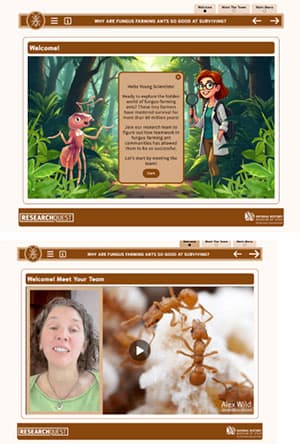
WHAT STUDENTS ARE DOING
Students will watch a short video that provides context for the investigation. You may find it easiest to watch this video together as a class or ask students to use headphones if they watch it individually.
TIPS FOR TEACHERS
After the video, encourage students to share any information about Fungus Farming Ants or the research team they thought was interesting.
2. Scientist Profiles
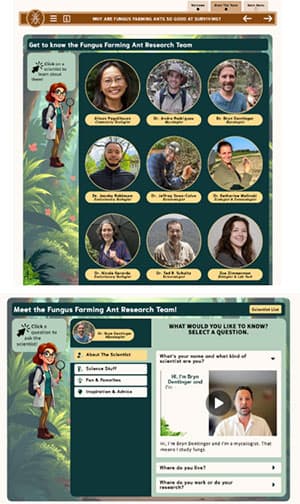
WHAT STUDENTS ARE DOING
Students can click on any of the scientists to learn more about them. Each scientist profile provides fun facts about their research and why they love their work.
TIPS FOR TEACHERS
Encourage students to find something in common with at least one scientist and share it with their learning partner.
3. Main Menu
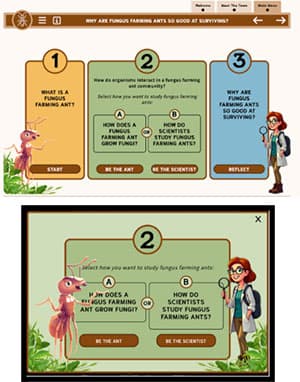
WHAT STUDENTS ARE DOING
Students will work through three labs. In Part 2 they have the option to do their research from one of two perspectives: Be the Ant or Be the Scientist.
TIPS FOR TEACHERS
Be the Ant is an interactive comic where students learn from the ant’s perspective.
Be the Scientist is a simulated experiment where students learn through trial, error, and observation just like a scientist.
Part 1: Setting the scene
Who’s on the research team?
(15 - 20 minutes)
OVERVIEW:
In this section, students get background information about fungus farming ants by activating their prior knowledge, watching a video that gives information about fungus farming ants, and then reflecting on their learning through a short quiz.
1. Turn and Talk
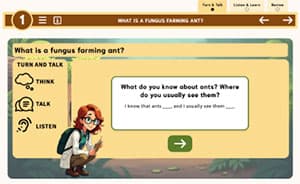
What do you know about ants?
One interesting thing about ants is ____.
Think about the last time you saw an ant. Where was it and what was it doing?
The last time I saw an ant, it was____.
What do you think ants need to survive?
In order to survive, ants need ___, ___, and ___.
WHAT STUDENTS ARE DOING
Students turn and talk with their learning partner about what they know about ants. The question generator can help guide their discussion.
TIPS FOR TEACHERS
Each question has an associated sentence stem to help guide students in answering the question.
Learning partners can talk about what they know or wonder. Have students share out with the class.
2. Informational Video
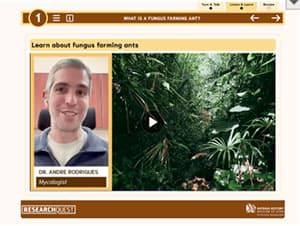
Background information & Quiz Questions:
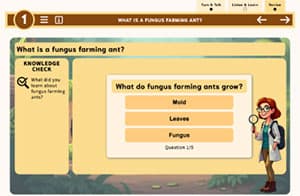
Q1: What do fungus farming ants grow?
A1: Fungus
Q2: What do fungus farming ants eat?
A2: Fungus
WHAT STUDENTS ARE DOING
Students will watch this scientist-led video that provides background information about fungus farming ants.
TIPS FOR TEACHERS
Students will listen for information about fungus farming ants and their communities in this video.
Help them identify the four living organisms of a fungus farming ant community.
3. Quick Quiz
Q3: About how long have fungus farming ants been living on Earth?
A3: 60 million years
Q4: Where do fungus farming ants live?
A4: Western Hemisphere
Q5: Where do the ants grow their fungus garden?
A5: Underground
WHAT STUDENTS ARE DOING
Students complete a quick 5 question quiz about some basics of fungus farming ants and their community.
TIPS FOR TEACHERS
Have students try this on their own, then if needed, with a learning partner.
You can also guide this reflection activity with the whole class, having students share their thinking. This allows you to ensure students have a strong foundation of the basics of fungus farming ants before beginning their research.
Part 2: Research
How do organisms in a fungus farming ant community interact?
[Choose which option students will do their research; Be the Ant or Be the Scientist]
PART 2A: Be the Ant
OVERVIEW:
In this section, students learn about fungus farming ants - from the ant perspective - through an interactive comic and game.
1. Informational Video
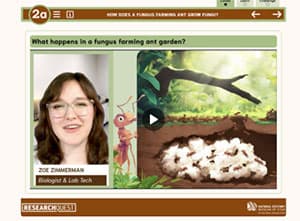
WHAT STUDENTS ARE DOING
Students watch this short video to prepare them to investigate fungus farming ants from the ant’s perspective.
TIPS FOR TEACHERS
Students will listen for directions and context.
2. Interactive Comic
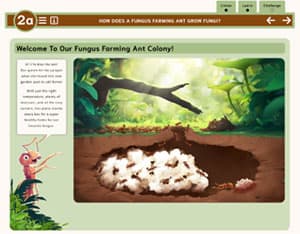
WHAT STUDENTS ARE DOING
Students read and interact with 15 comic panels including four interactive games in the style of “Overcooked.”
- Feed the fungus
- Feed the queen
- Take out the trash
- Final Game: Do it all at once
TIPS FOR TEACHERS
Students will learn about who lives in the garden, the jobs that have to be done and how each organism interacts. Encourage them to notice who eats what, who attacks who, and who protects who. They will keep track of their learning in their Research Assistant Notebook.
3. Final Game
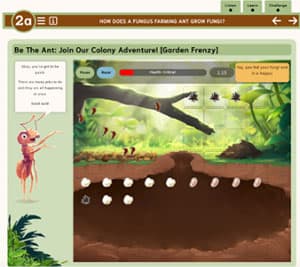
WHAT STUDENTS ARE DOING
Now that students have learned all the jobs they have to create a thriving Fungus Farming Ant community by doing all the jobs at once.
TIPS FOR TEACHERS
Consider a class competition. Who can create a THRIVING garden the fastest?
Make it into a review activity where students explain what is happening in their garden.
For example:
“The ants are feeding the fungus!”
“The ants eat the fungus!”
“The ants remove the mold!”
“The mold attacks the fungus!”
Part 2: Research
How do organisms in a fungus farming ant community interact?
PART 2B: Be the Scientist
OVERVIEW:
In this section, students learn about fungus farming ants from the scientist's perspective through an interactive experiment.
1. Informational Video
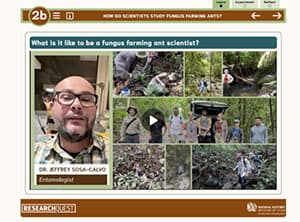
WHAT STUDENTS ARE DOING
Students watch this short video to learn how scientists collect and prepare fungus farming ant communities for research.
TIPS FOR TEACHERS
Students will listen for information about how scientists collect and prepare fungus farming ants for study.
Help students review the four living organisms of a fungus farming ant community. Do they have any predictions for how these organisms interact?
2. Interactive Experiment
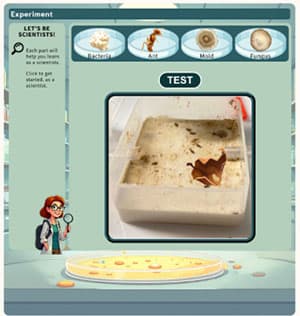
WHAT STUDENTS ARE DOING
Students will click on any combination of organisms to add them to the testing container. Then click “TEST” to see the results. Students should be recording their results in their RAN.
TIPS FOR TEACHERS
Remind students to use their RAN to keep track of their results and where they are in their research. Have them work together with their learning partner to complete all 15 possible combinations.
Model how to use their RAN to take fill-in-the-blank notes where they will enter one of the four organisms in each blank. (Print is hand written. Digital is a dropdown menu.)
3. Final Game
WHAT STUDENTS ARE DOING
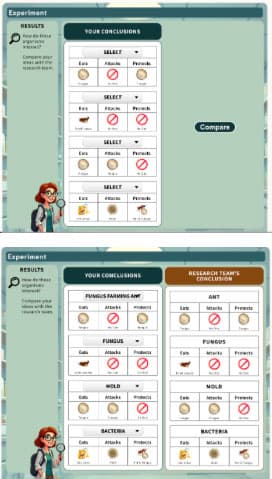
Students summarize their findings by categorizing each of the four organisms based on their experiment results. Then they click “Compare” to see the research team’s results.
TIPS FOR TEACHERS
Encourage students to compare their notes with the scientist’s notes. Where they have different findings they can repeat their tests.
PART 3: Share
Why are fungus farming ants so good at surviving?
(20 - 30 minutes)
1. Review Video
WHAT STUDENTS ARE DOING
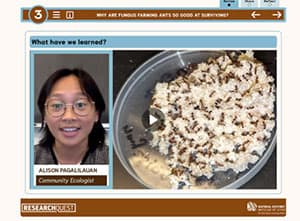
Students watch this short video to review what they learned about fungus farming ants and their community.
TIPS FOR TEACHERS
Help students review what they learned about fungus farming ants through a guided classroom discussion.
Use this to evaluate what support students will need to communicate their findings. Will they choose their format or will you. Consider modeling how to use the format(s).
2. Choice Board
WHAT STUDENTS ARE DOING
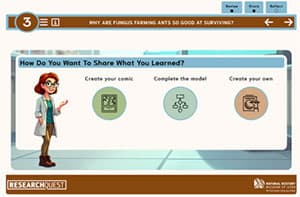
Students will be able to select (or you can pre-select) the format they want to use to share their findings.
They can create their own fungus farming ant comic, a symbiotic relationship model, or create their own.
TIPS FOR TEACHERS
Students can work individually or with their research partner to complete one of the selected templates.
Note: there are print and digital copies available for each of these options.
The ‘create your own’ option could include writing a short paper/story if you want to practice writing. Or a dance/drama piece describing a FFA community. Here is a list of ideas.
3. Reflection Video
WHAT STUDENTS ARE DOING
Students watch this short video to reflect what they learned and accomplished throughout the investigation.
TIPS FOR TEACHERS
Consider using this as an opportunity to celebrate the work and critical thinking they did throughout the investigation.
Either before or after the video have students share the work they created with their research partner or another set of research partners.
Celebrate success!
Extension: You might consider using this as an opportunity for students to talk about other symbiotic relationships in their community or the natural world - organisms that farm and/or protect each other.
This is the end of Part 3 and of the investigation. Check out one of our other Research Quest investigations on our website, https://researchquest.org.
Support Materials
Teacher Keys to help select the support materials that are right for your students.
RAN Research Key
| ANT | ||
| EATS | ATTACKS | PROTECTS |
 Fungus Cultivar |
 No one |
Fungus Cultivar |
| Helps | Helps | |
| FUNGUS | ||
| EATS | ATTACKS | PROTECTS |
 Dried Leaves |
No one |
No one |
| Helps | ||
| MOLD | ||
| EATS | ATTACKS | PROTECTS |
 Everyone |
No one |
| Harms | Harms | Harms |
| BACTERIA | ||
| EATS | ATTACKS | PROTECTS |
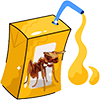 Ant juice |
 Escovopsis |
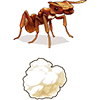 Fungus Cultivar |
| Helps | Helps | |
Model Maker Key