
Teacher Support Materials
Decomposition- It’s a Dirt-y Job! Instructional Guide
CENTRAL QUESTION: What role do fungi play in the cycling of matter in dry (xeric) and moist (mesic) environments?
TIME: 85-120 MINUTES
Overview:
- PART 1: Ready, Set, Rotten! (20-30 minutes)
How long does decomposition take? - PART 2: Hidden Soil Heroes (45-60 minutes)
Why is matter cycling faster in some ecosystems than others? - PART 3: Human Help or Harm? (20-30 minutes)
How do human activities affect decomposition and matter cycling?
MATERIALS:
- One device (laptop or Chromebook) per student or pair of students
- Printed or Google Doc Research Assistant Notebooks for students to record notes
- White board or other surface for teacher to use while facilitating class discussions
- Additional resources:.
- Teacher Guide Measurement Tool (for use during Part 2: Hidden Soil Heroes)
- Student Learning Assessment Tool
- Student Rubric for Presenting Arguments
- Student Rubric for Assessing Learning Outcomes
STANDARDS ALIGNMENT:
NGSS- MS-LS2-1 Ecosystems: Interactions, Energy, and Dynamics. Analyze and interpret data to provide evidence for the effects of resource availability on organisms and populations of organisms in an ecosystem. [Clarification Statement: Emphasis is on cause and effect relationships between resources and growth of individual organisms and the numbers of organisms in ecosystems during periods of abundant and scarce resources.]
- Standard 6.4.3: Develop a model to describe the cycling of matter and flow of energy among living and nonliving parts of an ecosystem. Emphasize food webs and the role of producers, consumers, and decomposers in various ecosystems. Examples could include Utah ecosystems such as mountains, Great Salt Lake, wetlands, or desert. (LS2.B)
- Speaking & Listening Standard 1: Engage effectively in a range of collaborative discussions (one-on-one, in groups, and teacher-led) with diverse partners on grade 6 topics, texts, and issues, building on others’ ideas and expressing their own clearly.
- Language Standard 6: Acquire and use accurately grade-appropriate general academic and domain-specific words and phrases; gather vocabulary knowledge when considering a word or phrase important to comprehension or expression.
GETTING STARTED
Before class...
- Check permissions on students’ devices to ensure they can visit researchquest.org and that they are able to download pdfs from that website.
- Login at www.researchquest.org using the email address and password you used to create your Research Quest account.
- Click “My Account” to access your unique student access code to share with your class.
- Note: Be sure to use the student URL <www.researchquest.org/student> and access code for classes. This allows you to keep your administrative account free of student activity. Students should not create their own Research Quest account.
- Click “My Account” to access your unique student access code to share with your class.
- Review this lesson plan, making notes on standards and/or skills you would like to focus on with your students.
- Review the following recommended strategies for optimizing student learning outcomes.
- During or after the investigation, you likely will want to pause for whole-class discussion to provide practice sharing and responding to peer ideas.
- Build a shared vocabulary for the learning tasks. Identify target vocabulary words from the vocabulary included in this guide and descriptions of student activities. Encourage students to use these words often. Model correct usage if needed.
- Think about places where you can activate prior knowledge by prompting students to relate new concepts to a familiar context.
- Think about how to integrate this EPIC investigation with other curriculum-aligned activities.
- Create and engage student interest in the program by expressing your enthusiasm and/or describing your personal interest in studying museum specimens and learning more about mammalogy, entomology and ecology. You may also want to emphasize that students will be working with authentic materials on research questions that scientists address in their own work. The scientist guide in this investigation is a real scientist studying museum specimens – not an actor!
- Introduce students to sentence stems that reinforce flexible thinking and help students verbalize their thought processes:
- “I see...”
- “I think...”
- “I wonder...”
- Provide a brief overview of the lesson to the class.
- Introduce the objectives the class will be focusing on today.
- Teacher Login at: www.researchquest.org using the email address and password you used to create your Research Quest account. Then, navigate to the Investigations tab.
- Students Login at: www.researchquest.org/student using the Student Access Code unique to your account.
- Locate and launch this investigation (“Decomposition: It’s a Dirt-y Job”)
- Once logged in, students will be on the landing page for this investigation.
Part 1: Ready, Set, Rotten!
How long does decomposition take?
(20 - 30 minutes)
OVERVIEW
Students make predictions about how long three objects (an apple, a stick, and a ground squirrel) will take to decompose in xeric (dry) and mesic (moist) environments. They will learn points based on how close their prediction is to the actual minimum length of time. After earning a badge based on their point level, students reason about differences between decomposition times in these environments and make predictions about what environmental factors may impact those differences.
VOCABULARY TO SUPPORT
decomposition, matter cycle, ecosystems, xeric, mesic, disintegrated, minimum decomposition time, producers, consumers, decomposers
BIG IDEAS TO SUPPORT:
- Decomposition happens faster in mesic (moist) environments than in xeric (dry) environments.
- Different objects decompose at different rates, even in the same environment.
ASSESSMENT
In this section, the instructor may find it useful to focus on the following critical thinking skills, defined in more detail in the Student Learning Assessment Tool located under the “Teacher Support” tab of the website:
- Observations: Encourage students to make observations about how long each object takes to decompose.
- Comparisons: Prompt students to make comparisons between the different lengths of time it takes for different objects to decompose.
- Connections: Students may be able to make connections between the mesic and xeric environments, the environment in which they live, and their own experiences with decomposition.
- Flexible thinking: Encourage students to share their thinking while also remaining open to why some environments may support different speeds of decomposition and why some objects decompose faster than others.
Learn-By-Doing
1. PLAY & REFLECT
WHAT STUDENTS ARE DOING
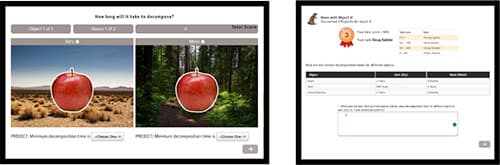
Students make predictions about the minimum amount of time it will take for three objects (an apple, a stick, and a ground squirrel) to decompose in a xeric (dry) environment and a mesic (moist) environment.
At the end of the game, students will answer four reflection questions that guide their reasoning about the differences between the speed of decomposition in xeric (dry) versus mesic (moist) ecosystems.
TIPS FOR TEACHERS
Don’t be afraid of productive struggle! The game is designed to require learn-by-doing and iterative strategy refinement. Students may not answer correctly but they can still learn from their results and share what they are learning with each other.
Is someone stuck? Encourage other students to help anyone who is stuck in a game round. Listen to the strategies they discuss as fodder for post-activity discussion!
Learn-by-Doing: Do not instruct students on differences in the time it takes for decomposition to happen. Let them dive right in and discover these ideas via experiential learning!
By the end of this section, students will see that there are differences in the amount of time it takes things to decompose in xeric (dry) versus mesic (moist) environments, but they don’t need to know why. They will have the chance to explore this phenomenon in more depth in parts 2 and 3.
Strategies for support: You may find it helpful to guide students’ reasoning toward the answers listed below as you monitor their conversations. Alternatively, use these questions with a full-class discussion to wrap up this section.
Wrapping it up: Facilitate a brief class conversation to reinforce the big ideas of this section and help students discover that xeric environments tend to support less life than mesic environments. Potential questions to ask:
- What are the characteristics of a xeric environment?
- What animals live there?
- What plants grow there?
- What is the weather like?
- What would the soil look like?
- What are the characteristics of a mesic environment?
- What animals live there?
- What plants grow there?
- What is the weather like?
- What would the soil look like?
Take it further: Students can design their own experiment to test how different factors (e.g., water, temperature) affect decomposition rates.
- They can create a mesic environment by adding moist soil and spraying water regularly to make sure it stays moist like a forest or riparian zone.
- To create a xeric environment, they might add dry soil, sands, and/or rocks to a container, simulating dry grasslands or desert conditions.
- In each environment, students can place organic objects and watch to see how long they take to decompose. Variations of this could include adding decomposers like earthworms and insects and tracking temperature and sunlight exposure.
This is the end of Part 1. Students may finish for the day or proceed to Part 2.
Part 2: Hidden Soil Heroes
Why is matter cycling faster in some ecosystems than others?
(45 - 60 minutes)
OVERVIEW
In this section, students generate their own data by sorting microscopic fungal remains from xeric and mesic ecosystems into categories. Analyzing these categories allows students to learn more about the role of fungi as decomposers in ecosystems and how fungi affect the rate of matter cycling in those systems. Students can also explore the differences in richness and abundance of fungal remains in wild (i.e. areas with low human interference) and urban (i.e., areas with high human interference) ecosystems by completing data collection for both urban and wild ecosystems or intentionally sharing their results with students who collected data from the ecosystem they did not study.
VOCABULARY TO SUPPORT:
matter cycling, soil, nutrients, fungi, ecosystems, xeric (dry) environments, mesic (moist) environments, decay, microscopic, fungal micro-remains (microscopic fungi), producers, consumers, decomposers, fungi abundance (# of fungi in the soil), fungi richness (how many different types of fungi are in the soil)
BIG IDEAS TO SUPPORT:
- Matter cycling and energy flow could not happen without decomposition.
- Microscopic fungi in the soil play an important role in breaking down matter into molecules, minerals, and nutrients that sustain life on Earth.
- Mesic ecosystems are home to more plants and animals, meaning there is more dead matter to break down and more fungi to break things down.
- Xeric ecosystems are home to fewer plants and animals, meaning there is less dead matter to break down and less fungi to break things down.
- Rates of matter cycling (i.e., how fast organic matter decomposes) are predicted by fungi abundance and richness.
ASSESSMENT
In this section, the instructor may find it useful to focus on the following critical thinking skills, defined in more detail in the Student Learning Assessment Tool located under the “Teacher Support” tab of the website:
- Observations: Students will make observations about fungi shapes in order to sort them into categories.
- Interpretations: Support student inferences about why mesic environments would have more plants and animals than xeric environments, and why xeric environments would have fewer plants and animals. More complex interpretations in this section might include making inferences about why there are more specialist fungi in mesic environments and more generalist fungi in xeric environments. Students will also be asked to interpret bar graphs to determine the abundance and richness of fungal micro-remains in xeric and mesic ecosystems.
- Connections: Encourage students to make connections between what they are learning about decomposition in mesic and xeric ecosystems and other related topics. For example, you could ask them about what organisms need to survive to draw attention to why mesic environments support more life.
- Comparisons: This section provides opportunities for students to make comparisons between fungal richness and abundance in wild (i.e., places with less human intervention) and urban (i.e., places with more human intervention) ecosystems.
Introduction
1. GATHER BACKGROUND INFORMATION
WHAT STUDENTS ARE DOING
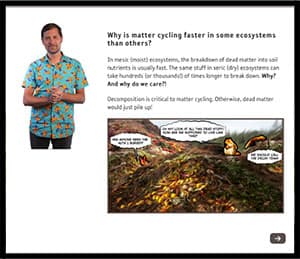
Read a comic to learn more about the role of fungi as decomposers and what impacts the speed of decompositions.
TIPS FOR TEACHERS
Students read four pages of a comic about decomposition and learn that the speed of matter and energy cycling can be predicted by the abundance and richness of fungi in the soil.
Strategies for support:
These comics are designed to communicate visually as well as through text. However, consider utilizing reading comprehension strategies to better support students’ comprehension of the background ideas in the text. Some potential strategies to draw from include:
- Ask questions that check understanding and keep students focused on the big ideas.
- Help students make connections between what they are reading and their prior knowledge of related topics.
- Prompt students to ask questions they have about the text as they read.
- Ask students to summarize and ask clarifying questions during and after they read.
2. Learn How
WHAT STUDENTS ARE DOING
Students learn about how scientists calculate the abundance and richness of fungi in soil by matching up the image with the correct description.
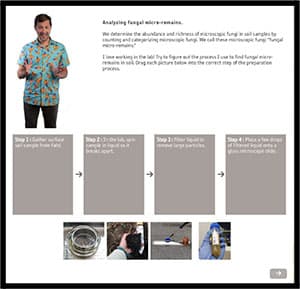
Is someone stuck? Images only stay in place when they are in the correct location. If an image isn’t sticking, prompt students to try adding it to a different box.
Next, students learn two steps to categorize microscopic fungi based on their structure and shape.
- First, they determine whether it is a single cell or cluster of cells.
- Second, they identify whether the shape is rounded, pointed, or elongated.
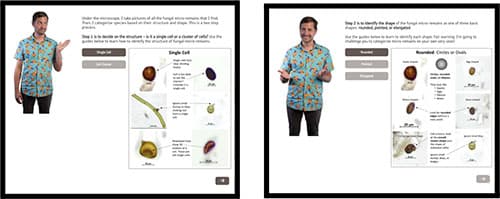
Is someone stuck? The “next” button will not activate until students have viewed all guide pages (i.e., they need to select “Single cell” and “Cell Cluster” buttons before the next button will activate).
TIPS FOR TEACHERS
The purpose of this activity is for students to learn more about how scientists calculate the abundance and richness of fungi in soil. Next, students will count and categorize microscopic fungi (i.e., fungal micro-remains) to categorize the abundance and richness of the soil where these fungi were collected.
Investigate
1. SELECT
WHAT STUDENTS ARE DOING
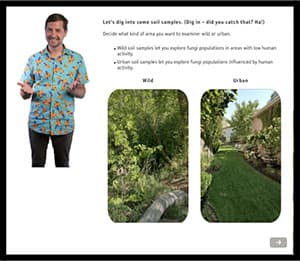
Select which location you want to investigate.
TIPS FOR TEACHERS
Students select which location they want to study. They choose first from wild (i.e., low human interference) or urban (i.e., high human interference).
2. Sort
WHAT STUDENTS ARE DOING
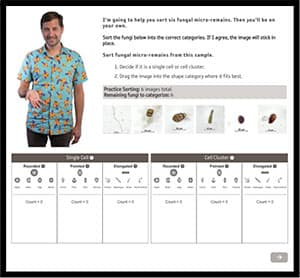
Choose a sample location to start with then use the sorting tool to categorize fungal micro-remains collected from that site. You’ll get one practice round where wrong answers don’t stick, and then you’ll be on your own!
TIPS FOR TEACHERS
Strategies for support:
Strategies for support: After completing the practice, students can sort fungi into any boxes without receiving an error message. This means that students have the potential to generate very inaccurate data if they are not at least attempting to follow sorting guides to match the basic shape.
Note, this is an instance where there are no clear right or wrong answers; some of these fungal micro-remains are hard to sort and require a judgment call. Use this as an opportunity to facilitate a discussion about the importance of communicating and comparing your results with others. In this case, you can encourage students to share their data with their peers to see how their findings match their peers’ findings.
3. Calculate
WHAT STUDENTS ARE DOING
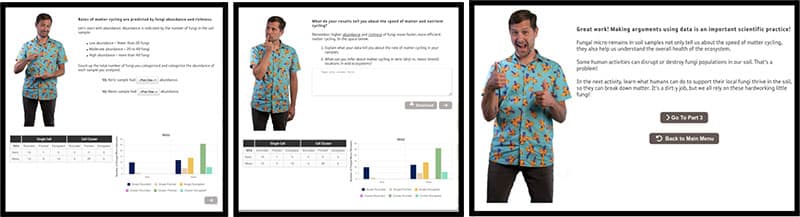
Students analyze the data they generated by sorting fungal micro-remains and answer two reflection questions. Students have the opportunity to download a PDF of their responses.
TIPS FOR TEACHERS
Strategies for support: Help students make inferences about the rate of matter and energy cycling based on the abundance and richness of fungi sound in the soil samples they analyzed.
We have created a teacher guide to data interpretation for teachers to use to guide their understanding of ideal data to be obtained from this activity. It can be found on the Support Materials page for this investigation.
Take it further!
This activity provides a good opportunity for students to share their data with each other and talk about any differences they found. Ask students to share their results in small groups or to the whole class, noting differences between results found in wild settings versus results found in urban settings. This will prepare students for the next activity, in Part 3, and give them opportunities to practice their speaking and listening skills.
This is the end of Part 2. Students may finish for the day or proceed to Part 3.
PART 3: Human Help or Harm?
How do human activities affect decomposition and matter cycling?
(20 - 30 minutes)
OVERVIEW
In this section, students reason about how human activities can change fungi populations and reflect on what they can do in their neighborhood to protect their local fungi.
VOCABULARY TO SUPPORT:
organic matter, soil, nutrients, resources, producers, consumers, decomposers
Big IDEAS TO SUPPORT:
- Decomposition helps keep matter and energy moving through ecosystems.
- Generally, darker-colored soil has more organic materials (including nutrients and other compounds essential for plant growth) than lighter-colored soil.
- Soil with more organic matter has higher fungi abundance and richness than soil with less organic matter.
- Human activity interferes with the natural balance of fungi in soil.
ASSESSMENT
In this section, the instructor may find it useful to focus on the following critical thinking skills, defined in more detail in the Student Learning Assessment Tool located under the “Teacher Support” tab of the website:
- Interpretations: Students make inferences about the impact of human activities on fungi in soil.
- Comparisons: Students compare soil samples that have more and less human interference.
- Connections: Encourage students to make connections to the soil around the school, their homes, and communities.
Soil Sort
1. Review
WHAT STUDENTS ARE DOING
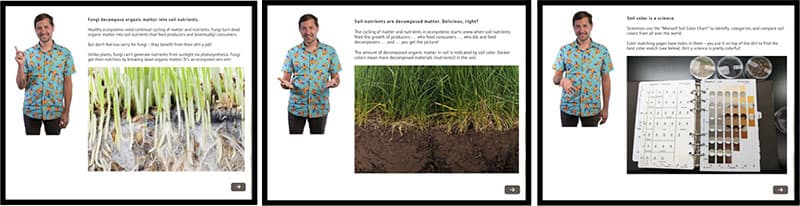
Students will review the role of fungi in matter cycling and learn that soil color is associated with the amount of organic material (nutrients) it contains.
TIPS FOR TEACHERS
Check for understanding of big ideas:
- Fungi decompose organic matter into soil nutrients.
- Soil nutrients move through the food ecosystem, feeding producers who then feed consumers, continuing the cycle.
- Fungi are not plants; they do not generate nutrients from sunlight via photosynthesis.
- Fungi get their nutrition from breaking down organic matter.
- The color of soil can tell you how much decomposed organic matter there is in the soil.
- Darker soil means more decomposed matter (nutrients) in the soil.
- Comparing soil colors allows us to compare soil nutrients; the darkest soil has the most organic material & nutrients, and the lightest soil has the least organic material & nutrients.
Strategies for support:
- Monitor your students as they move through the first few pages of Part 3, asking them to summarize their understanding and guiding them toward the big ideas.
- Help students connect what they already know about decomposition and matter cycling to the ideas presented in the text.
2. REVIEW
WHAT STUDENTS ARE DOING
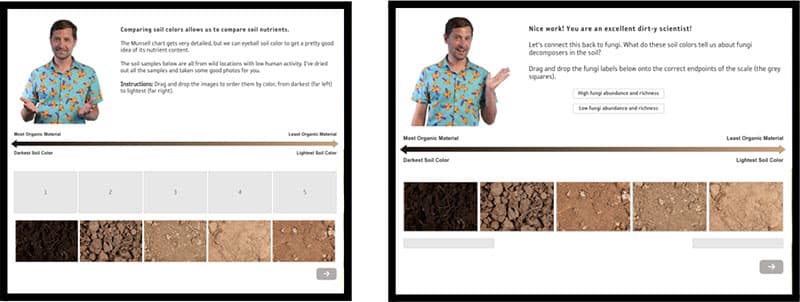
Sort the soil samples from dark to light, then add labels to show which side of the spectrum has high fungi abundance and richness, and which side has low fungi abundance and richness.
TIPS FOR TEACHERS
Students drag soil images to the correct location on the soil spectrum, then drag labels indicating which side has high fungi abundance and richness and which side has low fungi abundance and richness.
Strategies for support:
The following prompts may help students reason about what soil color can tell them about the abundance and richness of fungi:
- How do fungi get energy? (from nutrients/organic material in the soil)
- How can you tell how much nutrients/organic material is in the soil? (the color; darker soil has more, lighter soil has less)
- Based on what we know about organisms needing food resources to survive, where would you expect to find more fungi abundance/higher numbers of fungi? (darker soil because it has more organic material for fungi to eat)
- Where would you expect to find more fungi richness/numbers of types of fungi? (Darker soil because it has more organic material for fungi to eat.)
3. Review
WHAT STUDENTS ARE DOING
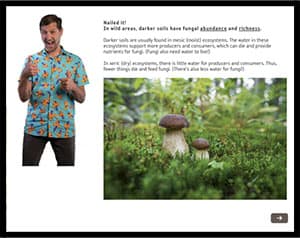
Students review why darker soil is associated with higher abundance and richness of fungi than lighter soil.
TIPS FOR TEACHERS
Check for understanding of big ideas:
- In wild areas, darker soils have higher fungal abundance and richness.
- Darker soils are usually found in mesic areas, because there is more moisture which can support more producers and consumers, which leads to more organic matter broken down in the soil.
- Lighter soils are often found in places with less water, where it is harder to support life. This means there are less things that live in the environment and that get broken down into organic material in the soil.
4. Reflect
WHAT STUDENTS ARE DOING
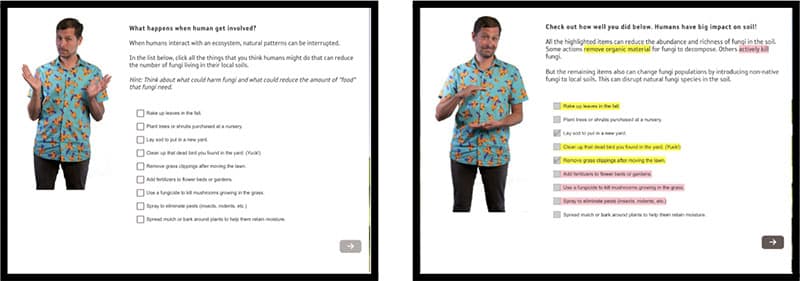
Reflect on what things humans might do that would reduce the number of fungi living in soils.
TIPS FOR TEACHERS
After submitting their response, they will receive feedback indicating that all the behaviors may change the number of fungi in the soil, but some remove organic material that fungi would need to eat, and others actively kill fungi.
For reference, these are their options and the associated impact on organic material in the soil:
- Rake up leaves in the fall. (removes organic material)
- Plant trees or shrubs purchased at a nursery. (adds organic material)
- Lay sod to put in a new yard. (adds organic material)
- Clean up that dead bird you found in the yard. (removes organic material)
- Remove grass clippings after moving the lawn. (removes organic material)
- Add fertilizers to flower beds or gardens. (may actively kill fungi)
- Use a fungicide to kill mushrooms growing in the grass. (actively kills fungi)
- Spray to eliminate pests. (may actively kill fungi)
- Spread mulch or bark around plants to help them retain moisture. (adds organic material)
Strategies for support:
Prompt students to think about which things might remove fungi and which things might reduce the amount of “food” available for fungi.
5. Reflect
WHAT STUDENTS ARE DOING
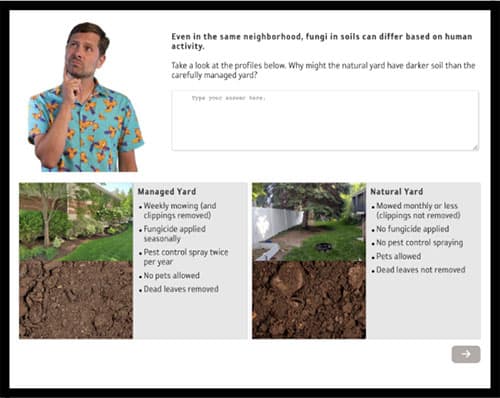
Students use what they know about the impact of adding, removing, and killing fungi to reason about why a managed yard may have lighter soil than a natural yard.
TIPS FOR TEACHERS
For reference, here are the facts provided about each yard to help students reason along with the implications of each of these actions for the amount of organic material in the soil:
- Managed yard:
- Weekly mowing with clippings removed (removes organic material)
- Fungicide applied seasonally (kills fungi)
- Pest control spray twice per year (kills fungi)
- No pets allowed (missed opportunity for additional organic material through pet waste)
- Dead leaves removed (removes organic material)
- Natural yard:
- Mowed monthly or less with clippings not removed (adds/maintains organic material)
- No fungicide applied (fungi are not killed)
- No pest control spraying (fungi are not killed)
- Pets allowed (organic material added through pet waste)
- Dead leaves not removed (adds/maintains organic material)
6. Choose
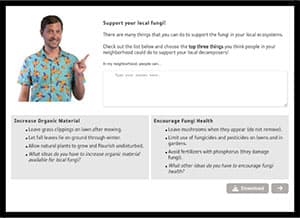 WHAT STUDENTS ARE DOING
Choose three things you and other people in your neighborhood can do to support your local fungi population and explain why that will support fungi.
TIPS FOR TEACHERS
Assessment opportunity: Consider gathering students’ downloaded responses so that you look more closely at how students are using evidence to support their reasoning and use that understanding to help students expand their abilities.
This is the end of Part 3 and of the investigation. Check out one of our other Research Quest investigations on our website, https://researchquest.org.