 In today’s science classrooms, teachers are constantly searching for ways to help students connect curiosity with real scientific thinking. For Lindsey Schutte, a 6th-grade science teacher at St. Croix Preparatory Academy in Stillwater, Minnesota, Research Quest provides exactly that — interactive investigations that transform abstract ideas into hands-on, meaningful learning experiences. Lindsey uses Research Quest to guide her students through the process of inquiry, evidence analysis, and scientific reasoning, helping them understand evolution in a way that feels both exciting and authentic.
Making Evolution Engaging: Real Science with “How Did Triceratops Evolve?”
One of the standout investigations for Lindsey’s students is How Did Triceratops Evolve? — an activity that quickly became a classroom favorite.
Lindsey shares, “My 6th-grade students really enjoyed using the ‘How Did Triceratops Evolve?’ lab. It was a fantastic resource for teaching how a species, like Triceratops, evolved over time.”
What made this lesson so impactful was how it allowed students to work like real scientists. By examining detailed 3D skull models, students practiced making careful observations and identifying subtle differences among specimens. Many of Lindsey’s students entered the lesson thinking of Triceratops only as the classic toy dinosaur they grew up with. But through this investigation, they discovered that Triceratops was actually a diverse group of animals, varying across different time periods and regions — a surprising and engaging realization that sparked deeper curiosity.
Building Critical Thinking Through Evidence and Patterns
Lindsey especially valued how the activity pushed students to go beyond surface-level observations.
“What I appreciated about this lab was that it pushed my students to analyze data carefully. They learned a new way to organize information and look for patterns through the use of phylogenetic trees.”
By constructing and interpreting phylogenetic trees, students developed essential scientific skills: organizing data, tracking evolutionary patterns, and thinking critically about how species change over time. This structure helped them not just learn about evolution, but experience it through the process of investigation.
To deepen their learning, Lindsey followed the Triceratops investigation with a second paleontology investigation: What Physical Features Helped a Dinosaur Survive? — an activity that her students loved. The creative, hands-on format allowed them to design imaginative dinosaurs while still grounding their choices in biological reasoning. Students connected previous lessons to their new creations, thinking critically about which adaptations would help their dinosaurs thrive.
Continuing the Investigation: Discovering New Phenomena
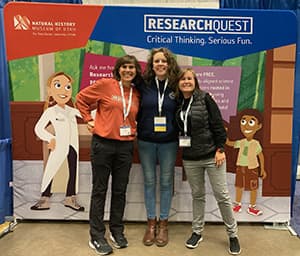
Lindsey’s dedication to Research Quest didn't stop in the classroom. She recently connected with the team at the NTSA Science Conference in Minneapolis, her home state, to see what was new. She was thrilled to see Research Quest expanding beyond paleontology into current ecosystem lessons, especially a new investigation focused on bats.
“I loved that students get to virtually examine bat stomach contents,” she said afterwards, “and I plan to bring this resource back to my middle school team.” The conference provided her, she said afterwards, with “ideas for using relevant, data-driven phenomena to create engaging and accessible learning opportunities for students.”
This new bat investigation, How will bat populations be impacted by the insect apocalypse?, like the Triceratops investigation, uses real-world evidence and hands-on virtual tools to teach complex ideas about how animals adapt to changes in their environment, ensuring Research Quest remains a vital resource for her and her colleagues.
Transforming Curiosity Into Understanding
For Lindsey, the most rewarding part of these Research Quest experiences was seeing her students truly engage in the scientific process.
“Overall, the lab not only deepened my students’ understanding of evolution but also sparked their curiosity about the natural world. It helped them see how species evolve, adapt, and change over time while giving them hands-on experience with real scientific thinking.”
Research Quest’s interactive lessons helped her students shift from memorizing facts to exploring ideas, building explanations, and supporting their thinking with evidence. Lindsey’s classroom shows how well-designed virtual investigations can make science meaningful, accessible, and exciting for young learners.
Inspiring the Next Generation of Scientific Thinkers
Lindsey Schutte’s experience demonstrates how Research Quest empowers students to approach science with curiosity, confidence, and authentic investigative skills. Through activities that blend creativity with critical thinking, her students gained a deeper understanding of evolution and a greater appreciation for how scientists study the natural world.
By giving students the tools to explore evidence, recognize patterns, and build explanations, Research Quest helps nurture the next generation of thoughtful, evidence-based thinkers — ready to ask questions, investigate ideas, and discover the science all around them.

Research Quest is a program of the Natural History Museum of Utah in partnership with The Utah Education Network